




HFBR-RUD500Z, HFBR-EUS500Z, and HFBR-EUD500Z are industrial plastic optical fiber (POF) cables from Broadcom (formerly Avago), designed for short-distance data transmission in environments with high electromagnetic interference.
This page provides reference information on the HFBR-500Z series, including basic design characteristics, EMI-resistant performance, and typical industrial applications. The three models mainly differ in cable structure and installation use, supporting fixed wiring, internal connections, and general industrial equipment integration.
The HFBR-500Z series, including HFBR-RUD500Z, HFBR-EUS500Z, and HFBR-EUD500Z, is a group of industrial plastic optical fiber (POF) cables originally developed by Avago and now part of the Broadcom product portfolio. This page provides reference information to support technical understanding and model comparison.
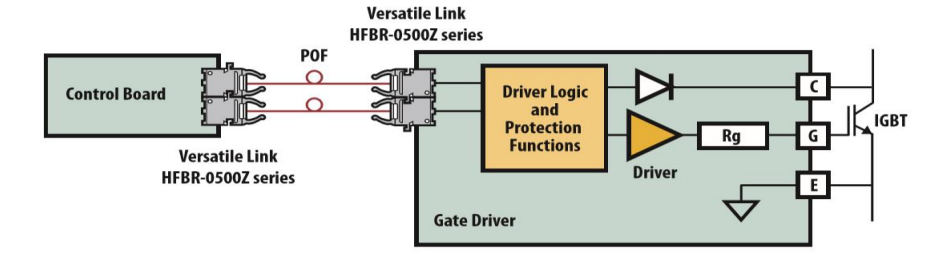
These cables are designed for short-distance optical signal transmission in industrial environments where electromagnetic interference (EMI) is present. By using plastic optical fiber instead of copper wiring, the HFBR-500Z series provides inherent EMI immunity, ensuring stable data transmission in factory automation systems, industrial control applications, and equipment-level communication links.
The HFBR-RUD500Z, HFBR-EUS500Z, and HFBR-EUD500Z share similar optical performance but differ primarily in cable structure and installation method. These differences make the series suitable for fixed routing, internal equipment connections, and general industrial device integration. Model selection is typically based on mechanical layout and installation requirements rather than transmission performance.
The HFBR-500Z series is widely used in industrial environments requiring reliable short-range optical communication, including:
Factory automation systems
Industrial control networks
Internal equipment communication links
Short-range device-to-device optical data connections
| Model | Cable Structure | Installation Type | Typical Application |
|---|---|---|---|
| HFBR-RUD500Z | Rigid jacket, standard POF | Fixed routing | Factory floor wiring, stable installations |
| HFBR-EUS500Z | Flexible jacket, standard POF | Internal equipment connections | Cabinets, machines, modular setups |
| HFBR-EUD500Z | Universal jacket, durable POF | General industrial integration | Short-range inter-device connections, flexible layout |
A1: The three models share similar optical performance. The main differences are in cable structure and installation method. HFBR-RUD500Z is typically used for fixed routing, HFBR-EUS500Z is suitable for internal equipment connections, and HFBR-EUD500Z is ideal for general industrial device integration.
A2: Yes. Using plastic optical fiber instead of copper provides inherent EMI resistance, allowing stable signal transmission in electrically noisy industrial environments.
A3: They are suitable for factory automation, industrial control systems, internal equipment communication, and short-range industrial network wiring, especially in environments with high EMI.
A4: Selection mainly depends on installation method and mechanical layout. For fixed routing, choose HFBR-RUD500Z. For flexible routing or internal equipment connections, HFBR-EUS500Z or HFBR-EUD500Z may be more suitable.
A5: The HFBR-500Z series uses plastic optical fiber (POF), which is multi-mode and designed for short-distance data transmission.
A6: The HFBR-500Z series conforms to industrial POF standards and can work with devices that support compatible POF interfaces and signal specifications. Compatibility should be confirmed based on the specific device interface and requirements.